
International SEO
International SEO is the process of optimising your website so it can appear in Google search results across different countries and languages.
This includes understanding the search intent behind foreign-language queries in your target markets, doing keyword research in other languages, creating properly localised content, implementing hreflang tags, and choosing the right international site structure. Whether that means using country-code domains (ccTLDs), subfolders, or another structure.
The main USP of SEO Tailor’s service is: building a bridge between international SEO and AI SEO.
I create my recommendations so, that your brand has a better chance of appearing in Google’s organic results across multiple countries (including AI Overviews) and in relevant LLM chat answers.
The process is efficient, transparent, and built on continuous testing. Instead of relying on assumptions, we work iteratively:
- we test,
- we validate,
- we improve,
- and we keep refining the strategy until we find what works in each market.
Use the table of contents if you want to jump straight to the answers that are most relevant to you. 😉
- For Whom International SEO Is Relevant?
- SEO Tailor: the bridge between International SEO and AI SEO
- How Is International SEO Different From “Traditional” SEO?
- What Do You Get If We Work Together?
- Why Work With Me?
- This Is What It Looks Like Working With Me, According To My Clients
- Frequently Asked Questions (FAQ)
- Let's Get In Touch!
- What Happens After Getting in Touch?
For Whom International SEO Is Relevant?
International SEO is relevant for any business that serves customers in more than one language, country, or cultural market.
It is especially important if your company targets different user segments based on language, location, culture, or market-specific needs. And if you want your website to perform well in each of those markets.
International SEO can be a good fit for:
- Non-Hungarian businesses that want to enter a new foreign market.
- Foreign companies and entrepreneurs who want to enter the Hungarian market.
- Hungarian entrepreneurs living abroad who are looking for a Hungarian SEO freelancer for their SEO project, whether they want to perform better in their current country or enter a completely new market.
I’m looking for businesses primairly targeting the DACH region, Croatia, and the United Kingdom. But I can support international SEO projects for almost any country or market.
SEO Tailor: the bridge between International SEO and AI SEO
SEO Tailor connects the dots between International SEO and AI SEO. With my methodology I shape recommendations throughout the project so that in every target country Google and other leading LLMs (ChatGPT, Gemini, Perplexity, Claude, etc.) will more likely pull your brand’s content into their answers.
The result: you generate more traffic from multiple international markets at the same time, while your AI visibility improves as well.
This means you can work towards two goals at the same time: generating more qualified organic traffic from multiple international markets, while also improving your visibility in AI-driven search and LLM responses.
Managing this across several countries is not simple. Without a clear structure, international SEO and AI SEO projects can quickly become difficult to oversee. And resource requirements can grow faster than expected. That is why I work with a transparent, structured and iterative process:
- we prioritise the right markets,
- test what works,
- validate the results,
- and improve continuously.

Local Content
You need to create content around the topics and questions that people actually search for in each market — and then prioritise those topics based on how important each target country is for your business.

Being Present On Relevant Platforms
Your brand needs visibility on the websites and platforms that are popular in each target country. Through backlinks, brand mentions, and guest posts, where AI systems tend to look for sources.

Low Cost Of Retrieval
You need to make it frictionless for AI to crawl, understand, and extract content from your international website. That means a strong internal linking structure and reducing the cost of retrieval.
Get in touch – you’ve got nothing to lose.
Worst case scenario, we’ll have a great conversation and you’ll walk away from the FREE CONSULTATION with a few pro-level SEO tips you can apply to your site immediately. Best case scenario? We kick off a collaboration that actually moves the needle.
How Is International SEO Different From “Traditional” SEO?
International SEO involves many of the same core activities as “standard” SEO, but you’re doing them across multiple countries, which makes the work inherently more complex. You need deeper analysis, tighter execution, and far more attention to detail.
Here’s what typically changes:
- Keyword research has to be done per target country.
- Content has to be localized. Your content needs to match local search intent, which can vary widely by market: what users consider “essential,” extra details they expect, and which content vehicles they prefer (article, video, infographics, interactive elements, etc.).
- Competitor analysis becomes country-specific. You often have a different competitive landscape in each market, with very little overlap, which makes research and benchmarking more time-consuming.
- You need backlinks from the local market. International authority is built market by market, not “globally” in one go.
- In some countries, you must pay extra attention to some SEO items you normally wouldn’t do. A good example is website speed in countries, where internet bandwidth is lower on average.
Because of this higher complexity, international SEO usually requires more time, more rigor, and therefore a higher budget than a typical SEO project. On top of that, link building is often significantly more expensive.
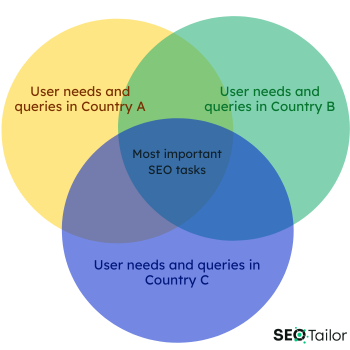
One of the most challenging parts of international SEO is content creation. You need to find the overlap: the key information that all target markets care about, and then add the extra details that are crucial for specific countries only.
Some SEO components become significantly more important than they are in “regular” SEO, for example:
- hreflang tag,
- localized pages (e.g., Spanish, German, etc.),
- site structure: ccTLD, subdomain, or subfolder?,
- using 303 redirects for language versions,
- separating language versions properly via internal linking, so URLs belonging to one language/country are strongly connected to each other, and don’t get mixed with other language versions.
Sometimes, Google isn’t the only search engine that matters. Depending on the target country, you may need to optimise for other search engines too, especially when they are widely used locally. Examples include Seznam in the Czech Republic, Naver in South Korea, Baidu in China, or Yahoo! in Japan.
And even within “Google-first” markets, the search market can differ. For example, Statcounter data (May 2026) shows Bing at roughly ~9–10% market share in both the United States and Germany, which is higher than many marketers assume.
| SEO Aspects | Traditional SEO | International SEO |
|---|---|---|
| Keyword Research | For one country, in one or more topics. | For more countries, in one ore more topics. |
| Content Creation | One country’s search intent must be satisfied. | Localized content is needed, content must match the user search intent of the international target countries, one-by-one. |
| Technical SEO Items | There’s no need for hreflang tags. | Hreflang tags are needed. In some countries items like website speed becomes more important due to external factors. |
| Link Building | Link building is typically done on one (national) market, at relatively low costs. | Typically more expensive as you must build links on more international markets. |
| Competitor Analysis | Relatively easy, must be carried out on one market, for 2-3 competitors. | Very complex, must be done for 2-3 competitors PER COUNTRY. Many times in more than one languages. |
| Most Important Search Engines | Typically just Google. | Apart from Google, other search engines can be important e.g. Bing, Seznam, Yahoo! etc. |
What Do You Get If We Work Together?
Here’s what I bring to the table in our partnership:
- International SEO audit + a re-audit every 6 months (or sooner if the situation calls for it).
- In-depth keyword research across multiple countries and languages.
- Deep competitor analysis, with 2–3 competitors per target market.
- A detailed SEO Roadmap built on the prelimiary research at the beginning of our parntership. This includes: tasks, priorities, owners, and a clear implementation timeline.
- Content briefs that map out exactly how to structure each article: suggested headings, hierarchy, context, what to talk about, and the best content format to use.
- Content wireframes for landing pages, built with the same logic as the article briefs, but with conversion-focus.
- AI SEO-focused testing and validation. This is how we iterate toward content that gets AI visibility.
- Proactive monitoring. I keep an eye on the data continuously and flag issues the moment I see anything impacting organic performance.
- Monthly reports.
- A collaboration that’s transparent, fast, and easy to work with. No fluff, no excuses, no vague “SEO talk.”
- If needed, a direct WhatsApp chat so you can reach me quickly with your questions.
Get in touch – you’ve got nothing to lose.
Worst case, we’ll have a great conversation and you’ll walk away from the FREE CONSULTATION with a few pro-level SEO tips you can apply to your site immediately. Best case? We kick off a collaboration that actually moves the needle.
Why Work With Me?
Hello there!👋
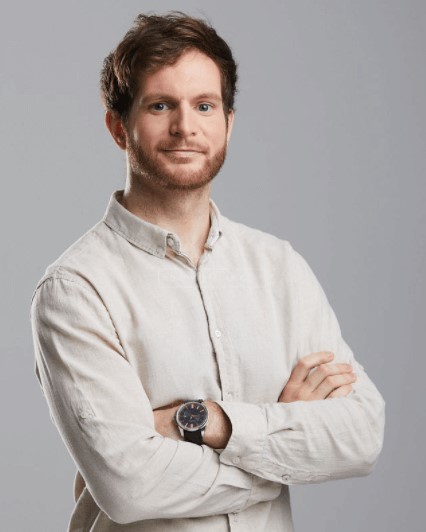
Csaba Szabó is the founder of SEO Tailor, a freelance international SEO consultant. He’s a former Head of SEO and a BrightonSEO speaker, who has been working in SEO for nearly 10 years, in startup environment, agencies, and as a freelancer.
He understands how key stakeholders (owners, developers, copywriters, and everyone in between) think and operate on the client side. That means he can always find solutions that satisfy everyone’s needs, realistic to implement, and deliver strong results.
His goal is to help you achieve your international growth targets through SEO in a partnership that’s transparent, collaborative, and genuinely enjoyable to work in.
You’re In International Hands Here
I’ve gained hands-on SEO experience across multiple markets, including Hungary, Switzerland, Norway, the UK, France, and Romania.
I provide international SEO services in four languages: Hungarian, English, German, and Croatian. And hopefully also in Japanese in a couple of years.
Fluent international language skills aren’t required for successful SEO, but strong proficiency and cultural awareness are a major advantage. It helps you pick up on the small language nuances and cultural differences that shape how people search, how they interpret content, and what they consider authentic content. With this knowledge I can assess international content more accurately, and better recommendations for improving it.
Recognized By The SEO Industry
I spoke at the following conferences in the last couple of years.


Trusted By Well-Known Brands
















What does a project look like in practice? Like this.
Read my latest International SEO case study, where I walk you through how we achieved massive organic growth and earned later AI visibility positions across many queries in many countries for a student accommodation provider in Budapest.
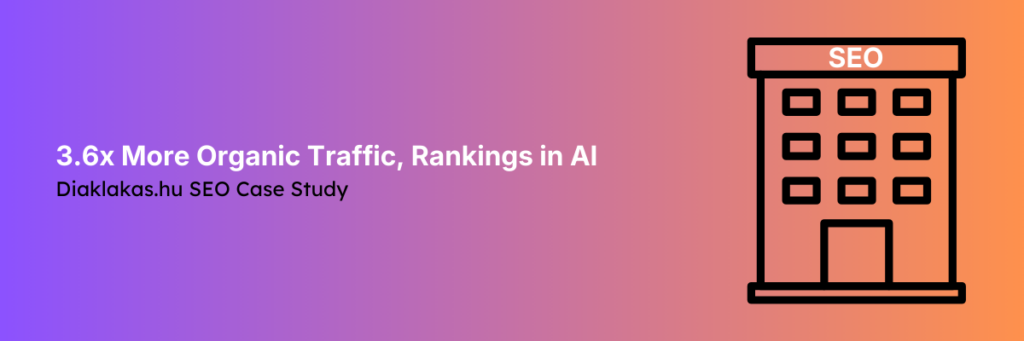
There are projects where, at the very beginning, you think: okay, I’ve definitely overcommitted. Not…
Frequently Asked Questions (FAQ)
1.
We’ll talk through the project: your goals, the main tasks, and the potential in the project.
This is also where we both find out whether there’s real client–consultant chemistry between us.
2.
Based on what we discussed, I’ll send you a tailored proposal.
It will outline the strategic direction I recommend, what to optimise first to reach results faster, and how you’ll receive the deliverables.
3.
We’ll go through the proposal in detail.
This is where we lock in the scope, responsibilities, and the most important KPIs.
4.
If everything looks good, we sign the contract and start the project. *whoop whoop!*
First step: I create a detailed SEO roadmap, including the priority task list and expected timeline.
Step 4 is especially important. This is where we align the SEO workflow with your business processes. This way we can involve every key stakeholder in the project and make sure the recommendations actually get implemented (not just documented).