
AI Visibility Growth
There are a lot of names floating around for work that’s related to making your brand show up in AI answers. AIO, GEO, AI SEO, Relevance Engineering, SRO (selection rate optimisation) – you name it. Different labels, same goal: to help your brand appear for as many relevant queries/prompts as possible – with a link, a logo, and an explicit brand mention.
The shift is already hard to ignore. According to Conductor’s 2026 research (The 2026 AEO / GEO Benchmarks Report), AI platforms already drive around 1.08% of global web traffic. First Page SEO research suggests ChatGPT has captured a meaningful share of global digital searches, powered by a user base of close to 900 million. And chances are you’ve seen this in real life too: people who use an LLM chat for everything when it comes to search. And barely using Google at all.
If your brand isn’t discoverable through AI answers, it becomes much harder for your target audience to find you.
The good news is: with good SEO work comes good AI visibility, as it still relies heavily on traditional SEO foundations. But some factors must be configured with an engineer mindset for effective ranking. Especially if the competition on that market is fierce.
Use the table of contents if you want to jump straight to the answers that are most relevant to you. 😉
- How is LLM Optimisation Different From “Traditional” SEO? Is it?
- What Does AI Optimisation Entail?
- How Do Large Language Models (LLMs) Work?
- Why Work With Me?
- This Is What It Looks Like Working With Me, According To My Clients
- Frequently Asked Questions (FAQ)
- Let's Get In Touch!
- What Happens After Getting in Touch?
How is LLM Optimisation Different From “Traditional” SEO? Is it?
If you follow the traditional SEO playbook, you’ll most likely rank in AI positions, too. However, you may need to dig deeper than you’d normally do in your analysis.
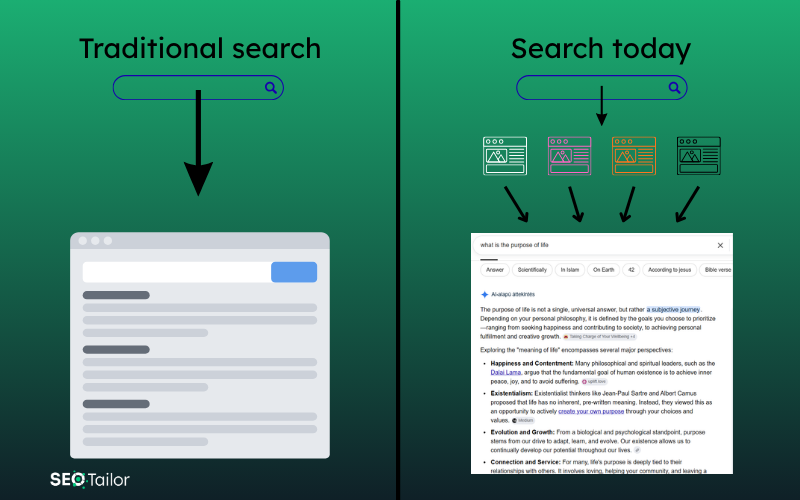
In classic SEO, the primary goal is to rank higher in the SERP. In LLM optimisation, the goal is get our content (and brand) into the AI chat’s answer.
We do this by making our brand’s content get selected during RAG. This can be done by fitting the selection pattern as closely as possible, so your content gets chosen as the source.
LLMs tend to follow repeatable patterns for how they “search” and how they select supporting content. We align your content and technical setup to those patterns so your pages match what the model is looking for.
What does that mean in practice? We optimise content and technical foundations so your brand gets associated with the right topic-specific attributes. This helps the AI recognise your brand as an entity that is relevant to the problem your target audience is trying to solve.
The real goal is for the LLM to treat your brand as an authoritative source based on algorithmic signals. A source that offers unique, useful, relevant information – one that’s not commodity content.
We want to make sure the system can retrieve the information at a low cost. See? Classic SEO again: if something is hard to crawl or can’t be retrieved, won’t be featured in LLM answers.
What Does AI Optimisation Entail?

Query fan-out keywords
We analyse what keywords the LLM searches for during fan-out to understand: (1) which queries you need to rank for, and (2) which external sites/platforms you should be present on.

Cosine distance between content
We structure and configure content so that semantically related pages sit close to each other in the embedding space after. And that internal links shall reinforce the “entity image” AI systems build about your brand.

Omnimedia presence
To increase AI visibility, you need to show up across all relevant the platforms where your audience looks for answers: YouTube, LinkedIn, TikTok, Instagram, Reddit, etc.

Easy comprehension and retrieval
We make it easy for LLMs to understand your site, and to retrieve information efficiently. Tools here include semantic HTML, structured data, and content that is easy to vectorise. The aim is to minimise the cost of retrieval.

Measuring AI-driven traffic
Tracking AI search traffic is still a bit tricky, but not impossible. Google Analytics, Bing Webmaster Tools, custom reporting, and third-party tools can help.

Prompt reverse-engineering
The user–LLM interaction is a “black box”. But based on ranking data and measurement signals we can in theory reverse-engineer what users are asking and searching for during conversations.
(Currently in beta.)
How Do Large Language Models (LLMs) Work?
An LLM (Large Language Model) is an AI model trained on massive amounts of text to learn linguistic patterns and relationships. This allows it to understand, summarise, rephrase, and generate text in a natural, human-like way.
When an LLM receives a prompt (a question or instruction), it predicts the most likely next words/thoughts based on learned patterns. Many LLMs can also generate images, video, or music.
However, LLMs have limits. They may have large training data, but they don’t contain all currently available knowledge. And constantly updating its knowledge base is expensive, as the volume of new information in the World grows faster than any team can keep up with. Put simply: an LLM can’t always know everything.
So when the model doesn’t know an answer (or the answer is too complex), it runs a search (typically in Google), to supplement its internal knowledge with fresh information from the web.
This is the query fan-out. The model transfers the user’s prompt into multiple search queries, checks the top-ranking pages, extracts the most relevant “information nuggets” (a paragraph, a sentence, sometimes even an image), and then synthesises a final answer.
One of the biggest downsides of LLM-driven answers is that they increase the share of zero-click searches. Similarweb data suggests zero-click made up about 69% of Google searches in 2025.
Why does this number grow? Because as the user gets a summary right on the SERP, they don’t need to click through multiple websites to find the information. In Search Console, this often shows up as increasing impressions and decreasing clicks. There’s already a name to this phenomenon: The Great Decoupling.
The upside: appearing in AI answers can significantly boost brand awareness, that can later translate into more branded searches.
What Are The Most Popular LLMs?
The most popular LLMs include:
- ChatGPT (OpenAI)
- Claude (Anthropic)
- Gemini (Google)
- Perplexity
- Copilot (Microsoft)
- Llama (Meta)
In practice, it usually makes sense to focus on the first three. Based on my experience, most users primarily rely on ChatGPT, Claude, and Gemini.
There’s still time to optimise your content so LLMs can find it, and use it as a source in their answers. If you want help with that, let’s talk!
Worst case scenario, we’ll have a great conversation and you’ll walk away from the FREE CONSULTATION with a few pro-level SEO tips you can apply to your site immediately. Best case scenario? We kick off a collaboration that actually moves the needle.
Why Work With Me?
Hello there!👋
Csaba Szabó is the founder of SEO Tailor, a freelance international SEO consultant. He’s a former Head of SEO and a BrightonSEO speaker, who has been working in SEO for nearly 10 years, in startup environment, agencies, and as a freelancer.
He understands how key stakeholders (owners, developers, copywriters, and everyone in between) think and operate on the client side. That means he can always find solutions that satisfy everyone’s needs, realistic to implement, and deliver strong results.
His goal is to help you achieve your international growth targets through SEO in a partnership that’s transparent, collaborative, and genuinely enjoyable to work in.

Recognized By The SEO Industry
I spoke at the following conferences in the last couple of years.



Trusted By Well-Known Brands


















Frequently Asked Questions (FAQ)
1.
We’ll talk through the project: your goals, the main tasks, and the potential in the project.
This is also where we both find out whether there’s real client–consultant chemistry between us.
2.
Based on what we discussed, I’ll send you a tailored proposal.
It will outline the strategic direction I recommend, what to optimise first to reach results faster, and how you’ll receive the deliverables.
3.
We’ll go through the proposal in detail.
This is where we lock in the scope, responsibilities, and the most important KPIs.
4.
If everything looks good, we sign the contract and start the project. *whoop whoop!*
First step: I create a detailed SEO roadmap, including the priority task list and expected timeline.
Step 4 is especially important. This is where we align the SEO workflow with your business processes. This way we can involve every key stakeholder in the project and make sure the recommendations actually get implemented (not just documented).